When you rent a Porsche 911 Carrera from Mogestic at $558/day, you're not paying for transportation. You're paying for the most precisely engineered passenger car on Earth — a vehicle so thoroughly considered that every gram of weight, every degree of temperature, and every millisecond of throttle response has been optimized by people who treat car building like watchmaking.
This is a deep dive into what you're actually getting when those keys land in your hand. Because understanding the 911's engineering makes the rental experience better — not in an abstract way, but in the way where you know what each mode does, why the car rotates the way it does through corners, and what that cabin is doing while you drive.
The Rear-Engine Layout: Why It Changes Everything
The 911's engine sits behind the rear axle — a layout no other production car uses. This isn't a quirk. It's the single most important design decision in the car's history, and it changes how the 911 behaves on every metre of road.
With the engine at the rear, the front end is light. That means when you enter a corner, the front wheels don't carry the engine's mass — they only carry the chassis weight. The result is a car that rotates through corners with a responsiveness that front-engine cars physically cannot replicate. The steering feels alive. Not nervous, not twitchy — just communicative. The car tells you what's happening at the contact patches through the steering column.
For Vancouver driving, this matters on the Sea-to-Sky Highway. The road has a section between Squamish and the Tantalus Lookout where the corners tighten and the elevation changes — and the 911's rear-engine balance means the car stays stable when front-heavy cars would be pushing under braking. It's the difference between feeling composed and feeling busy.
It also matters for wet weather. The 911's weight distribution gives it exceptional stability in rain — the rear mass keeps the car planted, and the light front end means the steering stays precise even when the front tyres are dealing with reduced grip. In a Vancouver downpour between downtown and Squamish, this is not a minor advantage.
The Twin-Turbo Flat-Six: 388 Horsepower of the Right Kind
The standard Carrera runs a 3.0-litre twin-turbo flat-six producing 388 horsepower and 331 lb-ft of torque. The engine is a development of the previous 911 GTS unit, with turbochargers carried over and an intercooler borrowed from the 911 Turbo model. The result is a engine that's been refined for three generations — not designed from scratch, but honed.
What this means in practice: the power delivery is immediate. The 911 doesn't have turbo lag. When you press the throttle, the response is linear and honest — no turbo spool-up, no power band that arrives two seconds later. This is why the car feels faster than its horsepower number suggests. It's not actually faster — it just delivers what it has, when you ask for it.
For renters, this matters at elevation. The Sea-to-Sky Highway climbs nearly 1,000 metres. At altitude, naturally aspirated engines lose power because the air thins — but turbocharged engines compensate by increasing boost pressure. The 911 at 1,000 metres doesn't feel like a car that's lost a step. It feels the same as it did at sea level. That's the turbo system working.
The PDK Transmission: 8 Speeds, Zero Wait
The 911 uses Porsche's proprietary Doppelkupplung (PDK) transmission — an 8-speed dual-clutch system that shifts faster than any conventional transmission on the market. The PDK can complete a gear change in under 30 milliseconds. For context, a standard dual-clutch transmission takes 80–120 milliseconds. The PDK is three to four times faster.
You don't feel gear changes in a 911. The car accelerates as if it's in one gear the entire time. This is why the 911 feels "single-speed" to drive — there's no surge, no lag, no moment where the transmission catches up to the engine. It's all one motion.
The T-Hybrid System (Carrera GTS): What If You Went Hybrid?
If you upgrade from the standard Carrera to the Carrera GTS, you get a fundamentally different powertrain. The GTS uses a 3.6-litre turbocharged flat-six combined with an electric motor integrated into the turbocharger itself, backed by a 1.9 kWh liquid-cooled lithium-ion battery. Combined output: 532 horsepower and 449 lb-ft of torque.
The T-Hybrid system eliminates turbo lag entirely. The electric motor fills the gap between throttle input and turbo boost — so the power delivery is not just immediate, it's perfectly immediate. There is no delay at all. The car also runs the air conditioning compressor electrically, which eliminates the belt drive that normally runs the AC — making the engine more compact and the cabin quieter at low speeds.
For renters, the GTS is the upgrade if you want the absolute peak of what the 911 platform offers. It's more expensive — but if you're doing a day on the Sea-to-Sky with stops at Shannon Falls and the Sea to Sky Gondola, the T-Hybrid system makes every acceleration from a standstill feel like the car was already moving.
The Cabin: What You're Sitting In
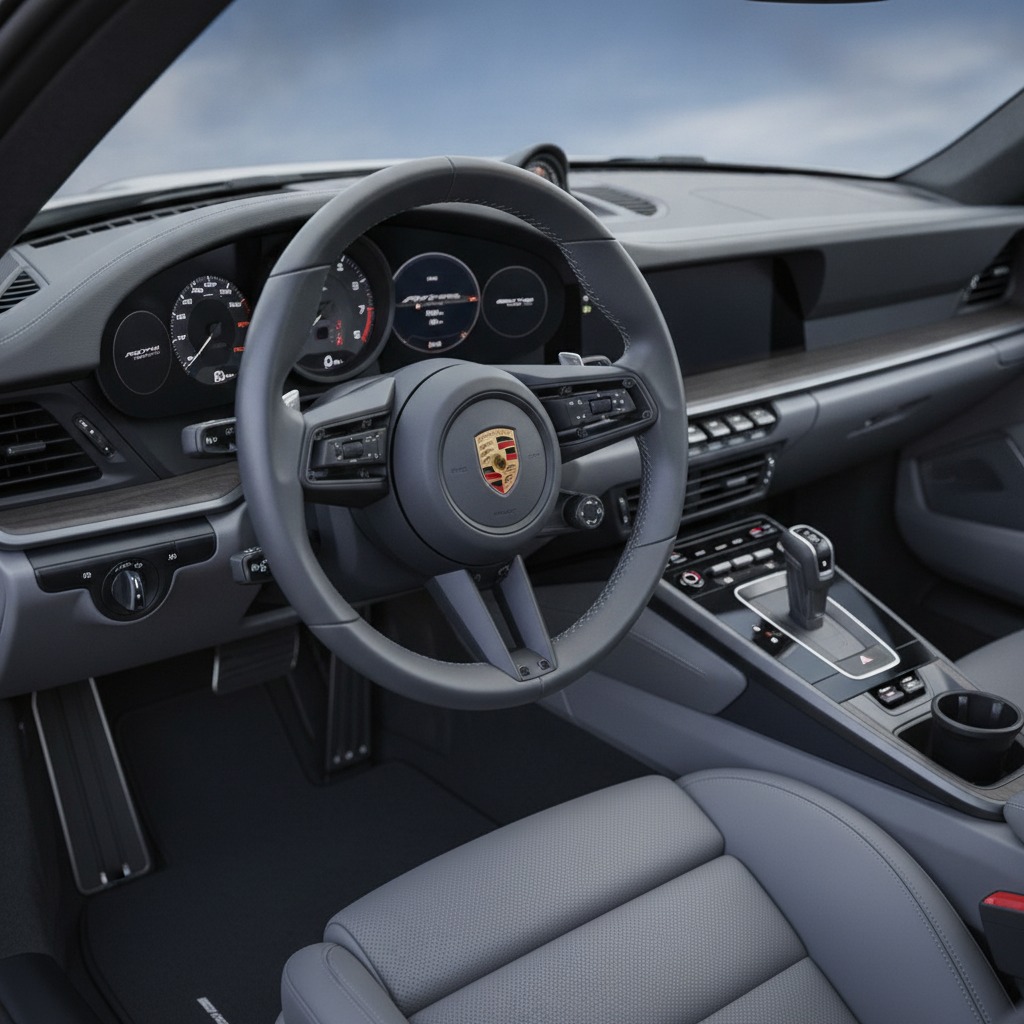
The 911's interior is one of the best cabins in any production car. Here's what matters for renters:
The Instrument Cluster
A fully digital 12.6-inch curved display with up to seven view configurations. The default view is the classic five-dial layout with a central tachometer — it looks analog but it's digital, which means you can switch to navigation, performance data, or a minimalist view. The display is in front of you, not to the side. You don't need to look away from the road to check your speed.
The Driving Mode Switch
On the steering wheel, a dial switches between Normal, Sport, Sport Plus, Individual, and Wet modes. Each mode changes throttle response, suspension stiffness, steering feel, and transmission shift points.
- Normal: Balanced, comfortable, efficient. This is what you use for city driving, parking lots, and traffic.
- Sport: Sharper throttle, tighter suspension, more direct steering. Use this on the Sea-to-Sky when you want the car to feel alert.
- Sport Plus: Maximum aggression. Instant throttle, firmest suspension, aggressive shift points. Use this on open highway sections where you want the car to feel like it's racing.
- Wet: Available on some models. Softens throttle response and increases stability control for wet conditions. Use this in Vancouver rain.
- Individual: Customize everything. Set your own throttle curve, suspension stiffness, and steering response. If you're renting for multiple days, take 10 minutes in Individual mode on a straight road and dial in your preferences.
Climate and Comfort
Standard 2-zone automatic climate control. Heated front seats and heated steering wheel are standard — and in a Vancouver winter rental, the heated steering wheel is genuinely wonderful. Ventilated seats are optional. The GTS model's electric AC means the cabin stays at your set temperature even when the engine is off at a stoplight.
Infotainment: Porsche Communication Management
A 10.9-inch central touchscreen running Porsche's PCM system. Apple CarPlay and Android Auto are standard and wirelessly integrated. The system supports native Spotify and Apple Music streaming, and CarPlay is deep enough that turn-by-turn navigation from your phone appears in the instrument cluster. There's a 15-watt cooled wireless charging tray for your phone — cooled meaning it won't heat up while charging, which is a small but genuine comfort feature.
How to Use the 911's Features During Your Vancouver Rental
Here's the practical guide to using what the 911 offers during a Mogestic rental day:
| Driving Situation | Mode | Why |
|---|---|---|
| Downtown Vancouver, city traffic | Normal | Smooth, efficient, doesn't attract attention. The 911 in Normal mode is composed in traffic. |
| Sea-to-Sky Highway, open sections | Sport | The car feels alert and responsive. The steering tightens up and the throttle sharpens — perfect for flowing highway corners. |
| Sea-to-Sky, overtaking slower traffic | Sport Plus | Instant throttle and firm suspension. Use for 30-second bursts when you need to pass RVs and trucks on the uphill sections. |
| Vancouver rain or wet conditions | Wet (if available) or Normal | Softened throttle response keeps the car stable when grip is reduced. The rear-engine layout already gives the 911 class-leading wet-weather stability. |
| Parking lots and parkades | Normal | Low-speed manoeuvring is best in Normal. The 911's turning circle is tight thanks to the rear-engine layout, so parking is surprisingly easy for a car this wide. |
| Sunset drive back to Vancouver | Sport | The golden-hour light on the Sea-to-Sky deserves a car that feels awake. Sport mode keeps the steering lively and the throttle honest. |
Frequently Asked Questions
Is the Porsche 911 difficult to drive if I've never driven one?
No — but it's different. The rear-engine layout makes the steering more responsive than most cars, which takes 10–15 minutes to get used to. Start in Normal mode on a straight stretch of highway. By the time you reach the first set of corners, you'll have the feel. The 911 is designed to be driven, not to drive itself. It rewards attention.
What's the difference between the Carrera and the Carrera GTS?
The standard Carrera runs a 3.0L twin-turbo flat-six with 388 horsepower. The GTS adds the T-Hybrid system — a 3.6L turbo flat-six plus an integrated electric motor, producing 532 combined horsepower. The GTS eliminates turbo lag entirely and adds electric AC operation. It's the more advanced car. For most Vancouver rentals, the standard Carrera is more than enough. The GTS is for drivers who want the absolute peak of the platform.
Does the 911 have Apple CarPlay?
Yes, wireless Apple CarPlay is standard. Android Auto is also standard. Both integrate deeply with the instrument cluster — navigation directions appear in the driver's display, not just the centre screen. It's one of the best CarPlay implementations in any car.
How does the 911 handle Vancouver rain?
Exceptionally well. The rear-engine weight distribution keeps the car planted when front grip is reduced, and the steering remains precise in wet conditions. If your 911 has Wet mode, use it. If not, Normal mode with the stability control engaged is more than sufficient. The 911 is one of the safest cars to drive in Vancouver's variable weather.
Can I adjust the driving mode while moving?
Yes. The mode switch on the steering wheel can be changed at any speed. The transition is seamless — the suspension, throttle, and transmission all adjust within a few seconds. You can shift from Normal to Sport mid-corner without issue.
Is the 911 worth the $558/day rental rate?
That depends on what you value. If you want transportation from A to B, no — take a standard rental. If you want the best driving experience available in a road car, yes. The 911 is the only car in Mogestic's fleet that offers rear-engine handling, PDK transmission speed, and the kind of steering communication that makes you a better driver. At $558/day, you're paying for the drive, not the destination. Call (604) 841-0366 to book.
The Bottom Line
The Porsche 911 Carrera is not the fastest car in Mogestic's fleet. The BMW XM has more horsepower. The G-Class has more cabin space. But the 911 has something neither of those cars has: it was designed from the ground up to be the best car to drive — not ride in, not be seen in, but drive. Every system in the car serves that purpose.
When you rent one from Mogestic, you're getting the result of 60 years of engineering refinement in a car that weighs less than 1,300 kg, produces 388 horsepower from a flat-six, shifts gears in 30 milliseconds, and steers like nothing else on the road. That's what $558/day buys.
Call (604) 841-0366 or visit mogestic.com to book the Porsche 911 for your next Vancouver drive.
Related posts
 04Sep, 26
 BMW XM vs Porsche 911 in Vancouver: Which One Books Your Day (2026)
 04Sep, 26