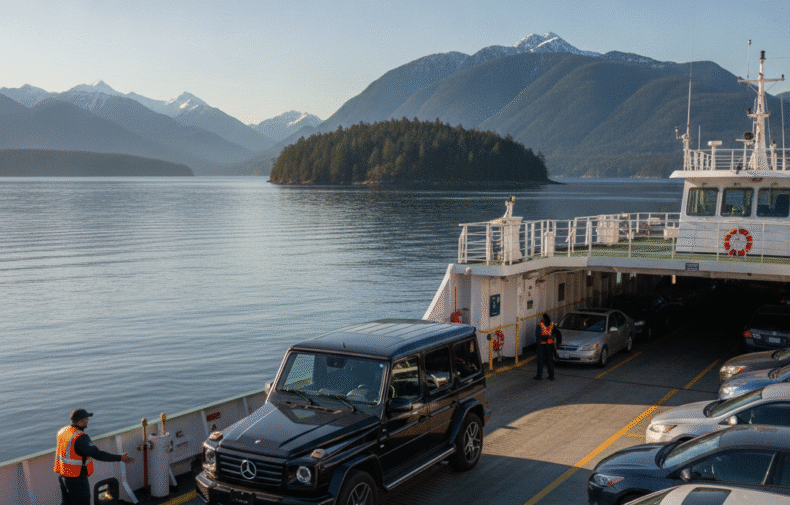
You booked a full-size SUV. You picked up a compact crossover. Sound familiar?
Every week on r/carrental, someone posts the same frustrated story: they reserved a full-size SUV for a family trip or a mountain drive, showed up at the counter, and were handed keys to something visibly smaller. When they pushed back, the agent pointed at the fine print: "or similar." No AWD badge. No third row. Half the cargo space they planned for. And technically? The rental company is in the clear.
The clause is real, it's everywhere, and it's the single most common "that's not what I paid for" complaint in rental threads. Here's why it happens, when it actually matters, and how to make sure the car you book is the car that shows up — especially if you're flying into Vancouver and driving north.
Why the "or similar" clause exists at big rental chains
Large agencies sell by class, not by model. You're not booking a specific car; you're booking a category — compact, intermediate, standard, full-size — and the company promises to give you "a vehicle in that class." It's a fleet-management trick. Big chains juggle thousands of cars across a city, and on a busy Friday counter, if the Ford Edge you were expecting is out on another rental, they'll swap you into whatever qualifies as "full-size-or-similar" that's sitting in the lot.
On paper, that promise holds. In practice, class definitions are looser than everyone would like:
- A "full-size SUV" on one platform can mean a three-row Grand Cherokee; on another, an Edge or a sorely stretched crossover that technically fits the cargo-volume ranges.
- Renters routinely notice the spec sheet shifted underneath them — from true 3-row SUV to a two-row crossover with a "similar" footprint.
- AWD/4WD is not guaranteed by the class label. Renters heading into mountain or snow country get bitten by this one constantly, and thread after thread ends with "you should have called the branch and asked."
"Or similar" is doing so much work in that contract that you'd think it was the peak of the argument. You booked a class, not a car. Whether that distinction feels like fine print or a scam depends on how badly you needed the thing you actually booked.
When the substitution actually ruins the trip
Sometimes the swap is genuinely harmless — a Corolla instead of a Camry, nobody notices. But three situations come up over and over in complaints where it matters:
1. Trekking into the mountains
If your plan includes the Sea-to-Sky Highway to Whistler between October 1 and March 31, BC law requires winter tires or chains on designated routes (most other BC routes run through April 30). AWD with proper tires isn't a nice-to-have here — it changes what the trip feels like. Getting bumped from an AWD rental into a front-wheel-drive crossover "of a similar class" is the classic fail case.
2. People and luggage — actually counted
Three adults, ski bags, a couple of duffels. A crossover that "fits the class" doesn't fit that weekend. Squeezed luggage, no visibility out the back, a road trip that starts with Tetris. Families on Reddit document this scenario constantly, and it's the one rental companies could fix with one sentence at booking.
3. The occasion matters
Some trips are about the car itself — the engagement, the anniversary, the "I'm finally driving something I'll remember." Substituting in those cases isn't a class adjustment; it's a different experience entirely. Nobody wants "or similar" applied to a birthday present.
The honest fix: book the model, not a class
Here's the thing nobody at a counter tells you: some rental companies quote at the model level, and that clause disappears entirely from your contract. When you reserve a Mercedes G-Class, you get the Mercedes G-Class — the boxy, three-row-feeling brute with G-Class presence that photographs exactly the way it did in the listing. Not its cousin. Not "similar."
That's how we've always operated at Mogestic. Our quotes name the exact vehicle: the Mercedes G-Class (from $625–$650/day) for the mountain-and-luggage trip, the BMW XM (from $888/day) when you want the tech-heavy flagship, the Porsche 911 Carrera (from $558/day) when the occasion is the point. One car, one spec sheet, one price — inspected before it heads out, cap-and-flag clean, with the deposit terms confirmed up front rather than discovered at a counter.
For Vancouver specifically, that model-level booking matters more than you'd expect. YVR arrivals, Whistler weekends, Stanley Park loops on a rainy afternoon — travelers here deal with enough moving pieces. Removing "will I actually get this car?" from the list of unknowns is the least-glamorous, most-valuable service upgrade in the industry.
Checklist before you book any rental, anywhere
- Confirm the model in writing. Screenshot the confirmation. If it says "full-size SUV or similar," decide if a substitution could ruin the trip.
- Call the pickup branch about AWD/winter tires. Front-desk agents can often flag commitments, at least within a chain — but nothing is guaranteed under the class model.
- Count your people and your luggage before you choose the class. Three rows is a spec, not a suggestion.
- Read the deposit/hold policy before arrival. Holds, not charges, but they eat your credit limit.
- If the day requires the exact car, book from someone who sells exact cars. This is the part big chains structurally can't promise.
Rent the car you actually picked
Vancouver travelers don't need to memorize class definitions or gamble on the counter's inventory. Call Mogestic at (604) 841-0366, tell us what the trip is — G-Class to Whistler, BMW XM for a city weekend, a Porsche 911 for the occasion you'll be photographed at — and that's the car that waits for you, ready, washed, and exactly as listed. The "or similar" clause is a problem for people who book a class. Book the model, and it's not your problem anymore.
Related posts
 04Sep, 26
 BMW XM vs Porsche 911 in Vancouver: Which One Books Your Day (2026)
 04Sep, 26